
Rollin', rollin', rollin' get them dice a rollin'... (Sung to the tune of the theme of Rawhide)
Hi, my name is Kim Remmers and I have an dice addiction!

How many people have played Tenzi? (Raising hands won't help here. But a shout out in the comments would.) It is a simple yet engaging game. While at The Nebraska Association for Gifted (NAG) conference several years ago I learned about it. Now, we play it in my classroom every so often to practice vocabulary, fact practice, concept review.... As soon as the students see me pull out the box (pictured in the left hand corner of the picture above), they immediately get excited.


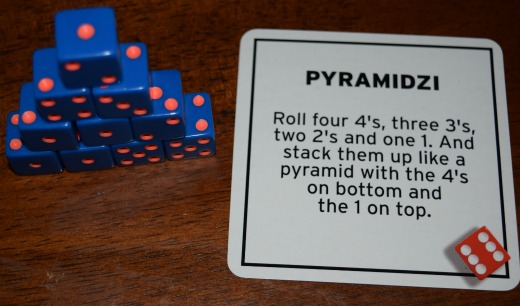
I have to confess here, I have bought a couple sets of actually Tenzi die and I have the 77 Ways to Play Tenzi card set. I love the ideas they spark! However, I am a poor teacher and pastor's wife who wanted 30 sets. I did find somewhere on the vast internet where I could buy die in bulk. I wish I could remember where I found them. Sorry! Racked the brain and no such luck. I always have enough for each student to have their own.
THE BASICS:
Basically, to play the game you roll all ten die and look for a specific number or combination of numbers. As you find them, you put them to the side. In the 77 Ways to Play Tenzi, you can find various ways to stack, place, or form pictures with the die. I will share some ideas here later. Once you have all the die with a particular number or pattern, then you shout out, "TENZI!"WAYS TO PLACE THE DIE:
1. Boneyard pile - simply shoved to the side.2. Tower - stack one on top of the other. If they fall, you start over.
3. Pyramid - four on the bottom, 3 next level up, 2 die then finally 1 at the top (I have seen where the number of dots matched the level.)
4. Assending or Desending - start with 1 and 6. (only need 6 die)
5. Double Trouble - two sets of die
*pattern: alternating pattern (AB or AABB or AAB)
*larger pyramid or tower
6. Picture patterns: 77 Ways to Play Tenzi (They are not paying me, I just feel they should get credit.) contains cards that have a pattern in which to place the die. The students could make their own.
QUICK START IDEAS FOR THE CLASSROOM:
1. Vocabulary practice - Rote disguised as fun! Everyone looks for a particular number, lets say 2s. As they find a two they say the word and definition. Guess what they have said it about 10 times by the end. Next word, new number.2. Fact practice - Simular as above but as they find the number they say the fact they need to practice. This can be done where they say the same fact or a series. In a series, they would say, 1X9 is 9; next time they roll the correct die they say 2X9 is 18. For each die they do the next fact. Four die in the pile means the fact is 4X___ is ___. I always write on the board the number we are trying to roll and the target practice.
3. Partner Quiz - This is another way to do the above. The first partner to roll the given number or has the most of that number gives a vocabulary word or fact. The other partner must respond with the definition or answer.
Alternative play: There is only one set of die between the pair. One person rolls and quizes the partner with the same number of vocabulary or facts as the amount of die with the specific number on them. The other partner answers that many questions then roles switch. They can create a pile of used die or all 10 are always rolled.
Want more ideas? I have a resource coming to Teacher Pay Teacher with additional ideas and resources to use with sets of die. The games are explained in more detail with direction cards incase you would like to use it as a center/station.
HAPPY ROLLIN'

