Showing posts with label vocabulary. Show all posts

Monday, July 3, 2017

Dot Cubes Games


Rollin', rollin', rollin' get them dice a rollin'... (Sung to the tune of the theme of Rawhide)
Hi, my name is Kim Remmers and I have an dice addiction!
As you can see, I have a few.

How many people have played Tenzi? (Raising hands won't help here. But a shout out in the comments would.) It is a simple yet engaging game.  While at The Nebraska Association for Gifted (NAG) conference several years ago I learned about it.  Now, we play it in my classroom every so often to practice vocabulary, fact practice, concept review.... As soon as the students see me pull out the box (pictured in the left hand corner of the picture above), they immediately get excited.
Image result for tenziImage result for 77 ways to use TenziImage result for 77 ways to use Tenzi

I have to confess here, I have bought a couple sets of actually Tenzi die and I have the 77 Ways to Play Tenzi card set.  I love the ideas they spark! However, I am a poor teacher and pastor's wife who wanted 30 sets.  I did find somewhere on the vast internet where I could buy die in bulk.  I wish I could remember where I found them. Sorry! Racked the brain and no such luck. I always have enough for each student to have their own.

THE BASICS: 

Basically, to play the game you roll all ten die and look for a specific number or combination of numbers.  As you find them, you put them to the side.  In the 77 Ways to Play Tenzi, you can find various ways to stack, place, or form pictures with the die. I will share some ideas here later. Once you have all the die with a particular number or pattern, then you shout out, "TENZI!"

WAYS TO PLACE THE DIE:

1. Boneyard pile - simply shoved to the side.
2. Tower - stack one on top of the other.  If they fall, you start over.
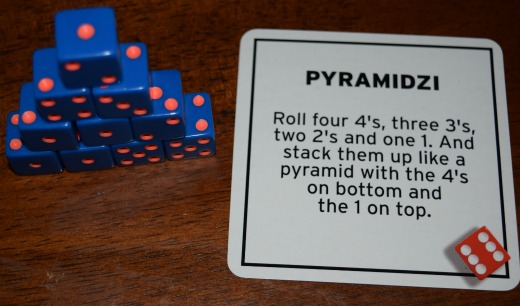
3. Pyramid - four on the bottom, 3 next level up, 2 die then finally 1 at the top (I have seen where the number of dots matched the level.)
4. Assending or Desending - start with 1 and 6. (only need 6 die)
5. Double Trouble - two sets of die
        *pattern: alternating pattern (AB or AABB or AAB)
        *larger pyramid or tower
6. Picture patterns: 77 Ways to Play Tenzi (They are not paying me, I just feel they should get credit.) contains cards that have a pattern in which to place the die. The students could make their own.

QUICK START IDEAS FOR THE CLASSROOM:

1. Vocabulary practice - Rote disguised as fun! Everyone looks for a particular number, lets say 2s.  As they find a two they say the word and definition.  Guess what they have said it about 10 times by the end. Next word, new number.

2. Fact practice - Simular as above but as they find the number they say the fact they need to practice.  This can be done where they say the same fact or a series.  In a series, they would say, 1X9 is 9; next time they roll the correct die they say 2X9 is 18.  For each die they do the next fact.  Four die in the pile means the fact is 4X___ is ___.  I always write on the board the number we are trying to roll and the target practice.

3. Partner Quiz - This is another way to do the above.  The first partner to roll the given number or has the most of that number gives a vocabulary word or fact.  The other partner must respond with the definition or answer.
    Alternative play: There is only one set of die between the pair.  One person rolls and quizes the partner with the same number of  vocabulary or facts as the amount of die with the specific number on them. The other partner answers that many questions then roles switch. They can create a pile of used die or all 10 are always rolled.

Want more ideas? I have a resource coming to Teacher Pay Teacher with additional ideas and resources to use with sets of die.  The games are explained in more detail with direction cards incase you would like to use it as a center/station.

HAPPY ROLLIN'


Sunday, January 1, 2017

Newest Read

The post title is a bit misleading as I have not technically been "reading" Ron Clark's The End of Molasses Classes.  I actually listen to it now and again. That is what I did on this first day of 2017 during my 3 hour drive home from Hays, Kansas this morning.


A couple points made me think about my teaching and how I can take what Ron Clark has to say into my classroom.

*Study Skills - Be delibrate in teaching them! DUH! I think I have done it.  Then I listened to his suggestions like taking one page of notes and ask the students to show you how they studied.  WOW! What you will see will be amazing.  So....looking myself in the mirror so to speak. I have NOT taught them quality study skills.  
    My goal: taking time each day to spend 5 minutes to delibrately teach these skills.
   How does this play into differentiation?? 
      Some of your students will need to have an outline that gives them the specifics and how to do this without your direct help.  Others have never needed to study, my husband.  They need to be made to study because when they get to college it may not be so easy.  So, how do you get them to see that it is important?  They need to be given deeper learning, higher language/vocabulary.  Anything that is just out of their reach so they have to engage their brain.  *Write a summary of the notes adding how this concept will change their life or be useful.  *Write a 7 word jingle or gist that will help them remember it.  *Find synonyms or antonyms to vocabulary and explain how knowing these alternatives help them to understand the original word.


*Use Music - Well, I do this but in the book it pushes it to new heights. I have even given them a choice of writing a rap or song for a project.  I have only had a couple kids actually do this.  But if the entire class worked together to develop a song that reviews or teaches a concept then it will STICK.  Again, nothing new, but a reminder that there are things we can take to deeper learning if we invest just a bit more.
     My goal: In our next social studies unit, I plan to use this technique to have students engrain the causes of the Revolutionary War.  I am sure there are songs out there. But if the students do it, it will stick.
   How does this play into differentiation?? 
     Use students talents...someone is good at writing, another has rhyme down to a science, the music lover can suggest a tune to write the song to, and the musician has rhythm or musical note knowledge to add to the project.  Everyone has a place to add what they are good at doing.

Here's the deal....
    SMALL STEPS  => BIG GAINS

  Sometimes as teachers we get a new book or go to PD and want to do it all.  FIND the one or two tweaks to your instruction.  If you go in a 180 degree directions the likelihood of you continuing is not in your favor.  Looking for that small tweak or addition that works into what you already do well, then you will come out on the side of success.  That is best practice for you and your students!!

As always, I would love to have comments, especially if you have read this book or visited RCA. 

Kim


Sunday, June 15, 2014

Vocabulary and Spelling


Vocabulary and Spelling

   I was going to answer a question posed this week by Teaching in the Fast Lane, http://4thgraderacers.blogspot.com/2014/06/wordless-wednesday-spelling-and.html, and found myself involved in a very long post.  Then thought...THAT IS IT!! Make it part of your blog!! Fantastic way to get back into blogging. (More on my last year and why I have been absent from blogging another time.)

   The question posed was simply wanted ideas on how to conduct spelling and vocabulary.
To see her actual question and responses use the link above.

   First, I believe there should be two discussions.  Vocabulary and spelling can coincide once in a while but in general they are two separate identities.  Vocabulary is about the understanding/knowledge of the word meaning. I use Anita Archer's explicit vocabulary strategies, which have transformed my teaching!! Here is one example of her work.  You can search and find many others.


   There are times that vocabulary and spelling coincide. When learning word parts (prefix, suffix...) you may have a word from the vocabulary that can be used for spelling. However, spelling list should be generated from words that the student will be using in writing regularly.  Primary and approaching upper elementary students should be using word families and commonly misspelled words. They still need a firm foundation. The on level and above upper elementary students usually look into spelling patterns involving multisyllabic words. 
    With all that said, the way I have found to get the best bang for the buck is when I have used individualized lists.  This is not how I did it last year since the district wanted us to try L to J, http://ltojconsulting.com/.  I do love the graphing and the idea of review and preview/spiral.  This is a phenomenal approach for average and some lower students.  It did not challenge my high students because they knew all the words already. My lowest students were frustrated until I modified each week to only 10 words.  I ended up managing 3-4 lists each week.  YUCK!

   My individualized lists give the students responsible for maintaining the lists.  Yes, there are a1-3 students whose spelling folder  needs to be kept safe or a copy made once in a while. However, in general, it is mainly the student's responsibility as 4th/5th graders to manage the list.

PROCESS


  As whole class instruction 2-3 times per week, have mini lessons/activities dealing with a pattern. There are several active games or interactive techniques.  I have a list of words that follow the pattern (10-15 words) usually found from reading series and the internet.  I have to always find the more challenging words for a pattern on the internet.  Our series lacks in depth of knowledge.   Everyone has a differing amount that they need to include on their list from this list. (I wish I would have thought of this while I was teaching...I would add a picture here!)  Then the remaining list (dependent upon grade level and ability level) are words from a list they have which includes word wall words and multisyllabic taught 3rd and under (list previously mentioned). They keep track of missed words from past lists and from writing assignments.  These are the words they utilize for filling in the remaining list.
    Research shows that students should only have 6 new words per week. ( Dr. Lee Jenkins, the developer of L to J has information if you would like to know the research.)  The rest should be words they have been exposed to previously. SO...a list of 20 would include 6 new words and 19 review words.  Repeated exposure being the key.  Another key is that the students do not know which of the previously taught word wall words or patterns will come up again.  I am still working on how to involve that portion of L to J with the individualized lists.


  I like using Spelling City for ease of grading and allows for practice opportunities. This coming year I will be using Spelling City's new individualized testing.  It comes at a cost, however.  I have not played with it as of yet, therefore, unsure how it will really work.  Sounds great on the site but we all know how that can go! 
   The last component of the process other than the mini lesson  and Spelling City are the contracts. You can find many contracts through Teachers Pay Teachers, Pinterest and other teacher created materials websites.  Mine are differentiated by giving choice of activities and there are 3 levels. Once my school computer can send e-mails again, I will attach a link here.
   Thank you, Teaching in the Fast Lane for providing me with the impetus to get my blog back up and running.

NOW.... If you made it to the end of this too long post...WHAT ARE YOUR THOUGHTS?  Do you agree/disagree?  Do you have any sparks of inspiration?  I cannot wait to hear what you are doing with instruction of spelling!! I always LOVE new ideas and inspiration.

Thursday, June 20, 2013

Just a quick thought


I was reading through several of my favorite blogs.  The Peanut Gallery came up through another blog I follow.  I have seen this game and even have fly swatters that say "SPLAT" on them just to play it.  Well...we played it once! Why? I don't like games where two kids are at a board and the "team" just sits back and watches. (Engagement???)   BUT as I read the game this time and author mentioned putting the words on a poster board, the light bulb lite up!  Make it part of your Daily 5 routine.  Make it a game/center to practice vocabulary.  YES!!! I could then see three kids in a group sitting around the "SPLAT" board.  Swat is the name I have heard it called but I call it Splat due to my flyswatters. One student would read a card with a definition or sentence containing a blank or synonym of the desired vocabulary word. The reason for the differing "question" cards is to differentiate.  The other two students with swatters in hand search for the vocabulary word.  I am now pumped to use my little used SPLAT swatters.  Now...to add yet another project to my long "Do Over Summer" list. :)   Thank you Peanut Gallery author (sorry don't know your name) for your inspiration!!

Friday, April 19, 2013

Math Vocabulary meets Pantomime

It is nearing the end of the year.  Though you would have thought we were at the end since before 4th quarter started!! Students are needing even MORE active learning to keep engagement at 90% level my district is striving to obtain.  So......
equivalent  

equilateral triangle

Hmmm...forgot which word they were. 
 I just loved laughter and pure fun they were having in
this picture.

What do you think the vocabulary word was for this one?
(think about it... I am sure you can telepathically see me
pointing to my temple as a signal to not respond.)
x
X
x
X
x
X
x
x
X
x
(think time......)
 
"1, 2, 3..tell me."
(Again, I am sure you saw the signal for speak!  :) )
YES! Denominator


I have a great group of future pantomimes! They did a terrific job. Only once or twice was it hard to figure out the vocabulary word.
   I am getting to be a proficient teacher of math vocabulary, solid 3. I decided in February after a quick exit ticket activity that we REALLY needed to focus on vocabulary EVERY DAY!  It has been working.  This was just one way we have practiced.  They love to toss the ball to music and review as well and vocabulary bingo.
   Now, I know I cannot open my student's brains and see if they were at 90% engaged when participating as the audience.  However, because of their interactions, I know they were paying attention better than just sitting and listening to me!  I would have been marked high for engagement when the groups were deciding what to do with their vocabulary word.  I would have dropped fast when they were watching as a whole group.  If you want to keep the "score" for engagement high, have your students pair with another group and show just them.  The "audience" would then be actively guessing together.  The groups would keep moving around the room until they have done their pantomime for everyone.

   Have fun building vocabulary connections inside your student's brains!
      Kim